
Primitive Reflexes
The Asymmetrical Tonic Neck Reflex (ATNR)
The pattern
Head and Arm Movement
The ATNR is an early reflex that causes a baby's arms and legs to respond when their head turns to one side. As the nervous system develops, this pattern typically becomes less prominent, allowing for more coordinated movement. When evaluating a child, we consider reflex patterns alongside their overall motor development, coordination, and everyday functioning.
A persistent ATNR reflex may present with challenges such as:
- ADHD
- Emotional and behavioral disturbances
- Visual teaming and tracking issues
- Dyslexia and spelling difficulties
- Difficulty with math
- Poor sense of direction
- Confused handedness, poor handwriting
- Difficulty crossing midline
- Poor focus
- Pelvic asymmetry
- Balance and coordination deficits
- Auditory sensitivities
- Opposition and defiance
Everyday life
Across the Middle
Some families notice that crossing the middle of the body, handwriting, or catching and throwing seem harder than expected. A lingering ATNR may be connected to these challenges, but it does not establish their cause.
The whole child
The Task Matters
We look at how both sides of the body work together during play and school tasks. We also consider hand skills, vision-related task demands, and the child’s environment as part of a full evaluation.
With PEAK
Deciding What Fits
The research on retained reflexes in older children is still growing. We use reflex patterns as one lens, then selects activities based on the child’s needs and functional goals.
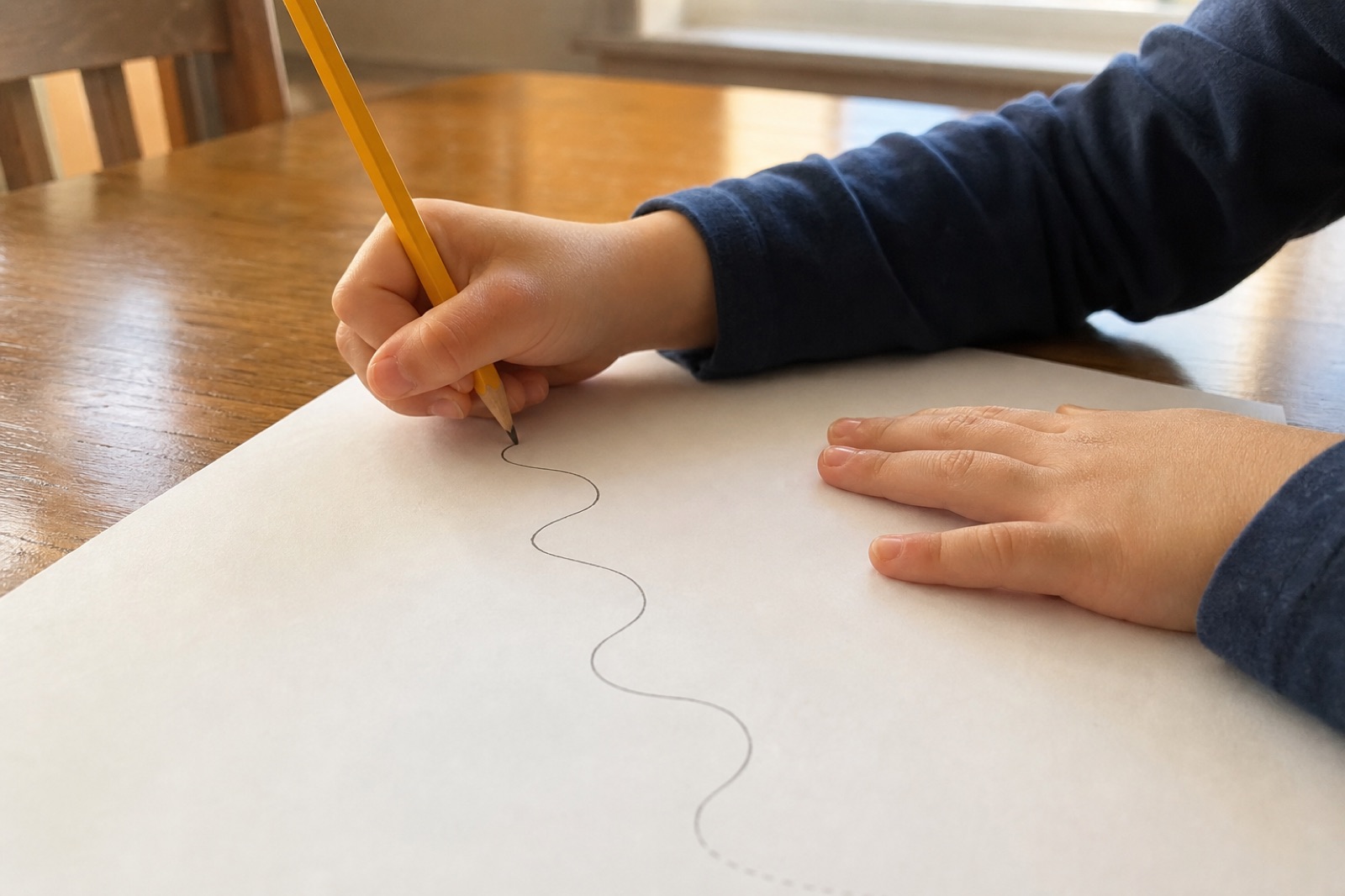
Handwriting is more than a pencil grip. We look at the entire task before making a plan.
What Parents Might Notice at Home
A parent might notice that reaching across a table feels awkward, that a ball game is frustrating, or that writing takes more energy than expected. Some families ask about ATNR when a child turns their whole body to use a hand on the opposite side. These observations may be connected to coordination or other task demands, not necessarily an early neck reflex. What matters is which activity the child wants to do and where it becomes difficult.
How This Fits Into an Evaluation
During the evaluation, we can watch a child use both sides of the body in play and ask about catching, throwing, and schoolwork. If it fits the concern, we may include ATNR assessment within a larger look at fine motor and coordination skills. We do not infer a diagnosis from how a child turns their head. We choose movement activities only after meeting and evaluating the child, with the family’s goals in mind.
The usual integration window is the first half year, not a deadline that explains later handwriting by itself. Studies of retained ATNR in older children do not yet give a simple explanation for an individual child’s writing. A desk setup, a writing demand, and the child’s comfort with movement can all matter. The related guide below discusses what else we consider when a pencil task is hard.
Messy Handwriting and Pencil Grip: When to Look CloserQuestions Parents Often Ask
Is crossing the middle of the body an ATNR test?
No. Difficulty reaching across the body can have different explanations. We look at the whole activity rather than asking parents to test a reflex at home.
Can ATNR explain my child’s handwriting?
A lingering pattern may be connected to some movement challenges, but it does not establish their cause. Writing also asks for hand skills, posture, and sustained attention.
What would PEAK do if the pattern seems relevant?
We may consider it within a full occupational therapy evaluation. Any movement activities are selected afterward for your child’s daily goals.
A place to begin
Start with a Conversation
Tell us which writing or ball games take extra effort.
Book a Free 15-Minute Consultation