
01 / 05
Early Movement Begins in Everyday Moments
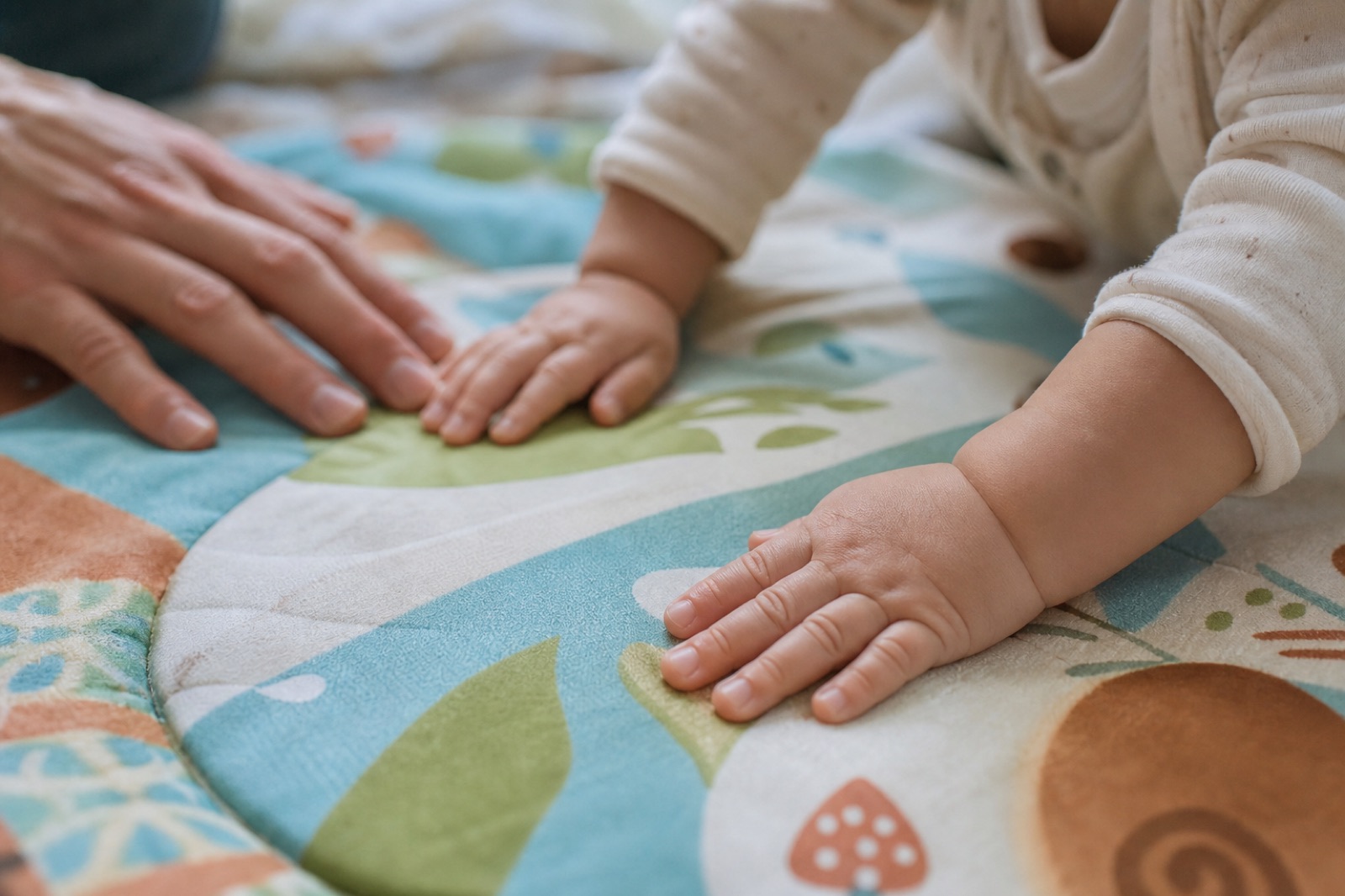
Tummy time is awake, supervised time that gives a baby chances to experience movement in a different position. It is one part of early development, not a test a parent has to pass. Babies explore by looking, turning, reaching, and learning how their bodies move. If your baby seems uncomfortable during tummy time or you have questions about early movement, you can ask the pediatrician and talk with an occupational therapist about what you notice.
Always follow your pediatrician’s safe sleep guidance. This guide is about awake movement and does not replace advice about sleeping positions, health, or safety. A baby who protests a position is communicating something, but one moment does not explain why. We start by learning about your baby and what happens during ordinary time together.
02 / 05
What an OT Might Look At
Pediatric occupational therapy can consider how a baby moves, reaches, grasps, reacts to sensation, and joins in early play. We may notice how a baby shifts weight, looks toward an object, or tolerates different positions while awake. Those observations are part of a broader look at participation and development. We do not diagnose a medical condition based on a baby’s reaction to tummy time.
Automatic early movement patterns, called primitive reflexes, usually integrate as the nervous system matures. When clinically appropriate, we may consider reflex patterns within a full occupational therapy evaluation. Research on retained reflexes in older children is still growing, and reflexes are not a stand-alone explanation for a baby’s difficulty. Parents can ask what we are observing and how it relates to their own concerns.
03 / 05
When to Ask the Pediatrician
If you worry about pain, a sudden change in movement, trouble breathing, or any other medical concern, speak with your baby’s pediatrician. If the pediatrician has raised a developmental question, that is also a good time to ask about occupational therapy. You do not have to make sense of a health concern from a page of general information or try to work out a diagnosis at home.
Parents may notice that a baby favors a position or does not seem interested in reaching. There can be several reasons for a pattern, and the pediatrician can address medical questions. We can describe how an OT evaluation looks at movement and daily play. The two conversations can complement each other without asking one provider to do the other’s job.
04 / 05
Parents Stay Close in Sessions
PEAK serves children from birth through age 18, including babies and toddlers. Our visits can happen in the family’s home, where a baby already knows the people, floor, and familiar objects. Parents are included in every session and can tell us which moments seem comfortable and which ones are hard. No one has to stage a perfect play space before we arrive.
We choose activities after evaluating the child rather than prescribing a sequence to try from a guide. We talk through what we notice in plain language. PEAK does not offer feeding therapy, so questions about feeding or medical symptoms belong with your baby’s pediatrician and the appropriate provider. Care for early movement can focus on play and participation without claiming to settle every developmental question.
05 / 05
A Gentle Start to a Conversation
If you are unsure whether your question belongs with an OT, the free 15-minute consultation is a place to ask. Tell us what your baby seems to enjoy and what has you wondering. An initial occupational therapy evaluation lasts 60 to 90 minutes. A diagnosis or physician referral is not required to start with PEAK, though an insurer may want a referral for possible out-of-network reimbursement.
We see families in Bozeman and surrounding areas in person. In-home care lets us look at early movement in a familiar setting while keeping parents involved. You can bring up advice you have received from the pediatrician so we understand the full context. There is no promise that one visit or one activity will change a baby’s development in a particular way.